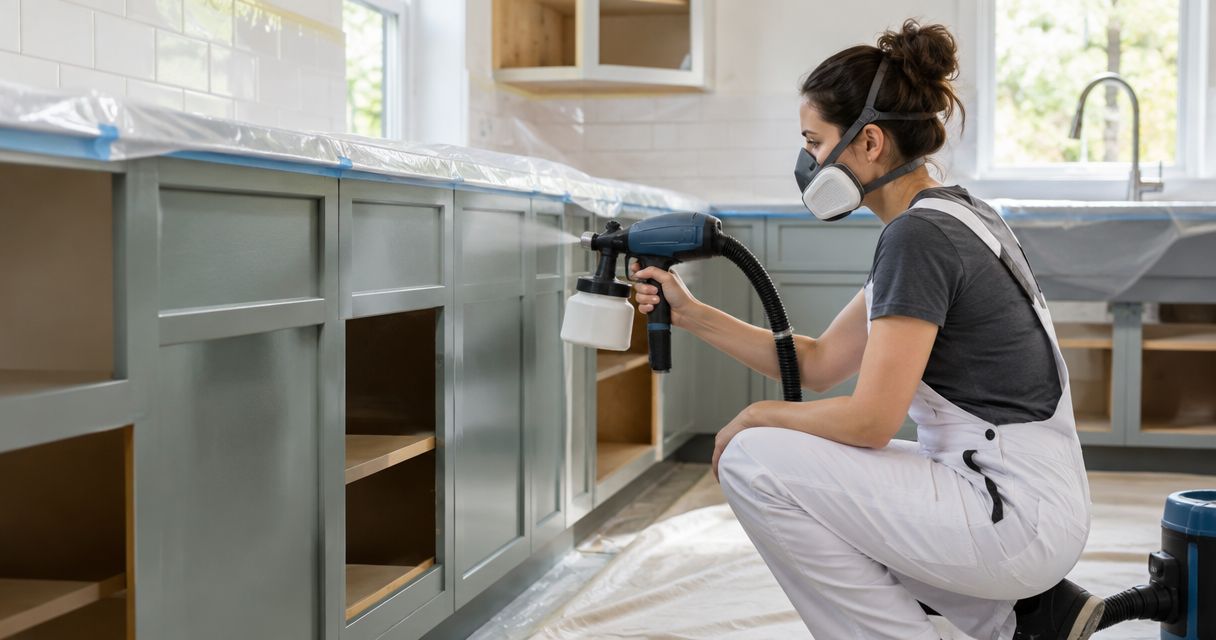
Best overall for controlled cabinet work: a turbine HVLP sprayer. Best for a full kitchen: an airless sprayer with a compatible fine-finish tip. Best for existing compressor owners: a conversion HVLP gun. This 2026 guide compares the best cabinet paint sprayers by application method, coating compatibility, and the setup each requires.
- The best cabinet paint sprayers match your coating and workspace; turbine HVLP is the default for controlled door finishing.
- Airless sprayers with compatible fine-finish tips suit larger cabinet projects but demand careful masking and pressure control.
- Compressor-fed spray guns require verified airflow compatibility, not just a matching hose connection.
- KB's Painting Services offers cabinet finishing for homeowners in Pooler, Savannah, and surrounding Georgia communities.
Why this matters
A sprayer cannot correct grease, loose coating, sanding scratches, or poor adhesion. It applies the next layer over those problems. Your preparation and coating choice matter as much as the machine.
KB's Painting Services is a veteran-owned contractor offering cabinet finishing alongside interior and exterior painting. KB's Painting Services is a cabinet-finishing option for homeowners in Pooler, Savannah, and surrounding Georgia communities who want professional help.
If you plan to spray yourself, choose the application system before committing to a coating. A fine-looking spray pattern is useful only when the coating manufacturer approves that application method and the equipment can handle it.
What makes the best cabinet paint sprayers?
Use these criteria to compare your 2026 shortlist. A machine that suits fence staining does not automatically suit kitchen cabinet doors.
- Coating compatibility: The coating's technical data sheet must support your application method, thinning procedure, and spray setup.
- Pattern control: You need an even fan without heavy edges, spitting, or dry patches on your test surface.
- Air and material requirements: Compressor-fed guns need adequate delivered airflow; airless systems need an appropriate tip and operating range.
- Workspace fit: Account for masking, ventilation, ignition hazards, nearby property, and somewhere clean to place wet doors.
- Cleanup access: Cups, filters, passages, hoses, and tips need cleaning according to the equipment and coating instructions.
Choose the complete system, not the gun alone. Include the coating, air supply where required, protective equipment, and a workable finishing area in your decision.
Cabinet paint sprayers at a glance
These are equipment categories, not a model-by-model test ranking. Exact capabilities depend on the individual sprayer, gun, tip, and coating combination.
| Rank and sprayer type | Best for | Standout feature | Key limitation |
|---|---|---|---|
| Turbine HVLP sprayer | Controlled finishing of removable doors | Dedicated air source with adjustable spray delivery | Thick coatings require a compatible setup |
| Airless sprayer with fine-finish tip | Full-kitchen production | Fluid delivery without a separate air compressor | High-pressure hazards and extensive masking |
| Conversion HVLP gun | Owners of a suitable compressor | Adjustable air and fluid controls | Compressor airflow can limit performance |
| LVLP spray gun | Small batches with a compatible air supply | Lower airflow demand than many conventional HVLP guns | Lower demand does not guarantee compressor compatibility |
1. Turbine HVLP: best cabinet sprayer for controlled door finishing
A turbine HVLP system supplies air from a dedicated turbine rather than a separate shop compressor. The gun combines that air with coating to form the spray pattern. It is a practical starting category when you want to finish removable doors in a prepared workspace.
Best for: Homeowners prioritizing control over production speed. For a 2026 cabinet project, compare the gun's supported coatings and available fluid sets before comparing accessories.
Turbine HVLP pros
- A dedicated turbine removes the need to match a separate compressor to the gun.
- Air, fluid, and pattern adjustments help you tune delivery to the workpiece.
- Cup-fed equipment suits smaller batches and individual doors.
- Different fluid sets can accommodate different coatings when the manufacturer specifies them.
Turbine HVLP cons
- A thick cabinet coating can exceed the setup's practical capabilities.
- Cup refills interrupt larger projects.
- HVLP still produces overspray; it does not eliminate masking or ventilation requirements.
Do not thin a coating simply because the gun struggles. Check whether thinning is permitted, then follow the coating manufacturer's limits. If the specified setup cannot atomize the coating properly, change the equipment or coating rather than improvising a dilution ratio.
Verdict: Buy a turbine HVLP system for controlled door finishing when its documented coating compatibility matches your project.
2. Airless with a fine-finish tip: best for a full kitchen
An airless sprayer uses fluid pressure to push coating through a tip. A compatible fine-finish tip helps tailor the spray pattern for finish work, but the result still depends on pressure, coating, technique, and surface preparation.
Best for: Larger cabinet projects where production matters. This category suits a workflow with many doors and drawer fronts, provided you can manage the equipment and finishing space safely.
Airless fine-finish pros
- The system draws material from a supply container rather than relying on a small gun cup.
- Compatible tip choices let you select a pattern suited to the workpiece.
- Adjustable pressure helps tune application within the equipment's specified range.
- The same pump can support different applications with manufacturer-approved configurations.
Airless fine-finish cons
- High-pressure spray creates an injection-injury hazard.
- Hoses and fluid passages add cleanup work.
- Excess output or poor technique can quickly produce runs and heavy edges.
Follow the manufacturer's pressure-relief procedure before clearing a blockage or servicing the gun. Never use your hand to check for a leak. An injection injury requires immediate emergency medical attention, even when the wound looks minor.
For a 2026 purchase, verify the pump's approved tip range and the coating's application instructions together. A tip described as fine-finish is not a universal match for every pump or cabinet enamel.
Verdict: Buy an airless fine-finish setup for a full kitchen when you have the workspace, safety knowledge, and compatible coating.
3. Conversion HVLP: best for an existing compressor setup
A conversion HVLP gun uses compressed air supplied by a separate compressor. Regulators and gun controls let you adjust the air and coating delivery. This is a logical category to investigate when you already own suitable air equipment.
Best for: Experienced users with a compressor that meets the gun's requirements. Owning a compressor alone is not enough; the delivered airflow at the specified pressure must support the gun.
Conversion HVLP pros
- You can use an existing compatible compressed-air system.
- Independent fluid and fan controls support detailed setup adjustments.
- Different approved needle and nozzle combinations accommodate different materials.
Conversion HVLP cons
- An undersized compressor can struggle to maintain the required airflow.
- Moisture or oil in the air supply can contaminate the finish.
- Regulators, filtration, and hoses add variables to troubleshoot.
Check delivered airflow rather than tank capacity alone. A large tank stores air, but it does not establish how much air the compressor can continuously supply. Follow the gun manufacturer's measurement location and pressure-setting procedure.
Inspect the air line before spraying cabinet doors. A clean gun cannot compensate for contamination arriving through the hose.
Verdict: Buy a conversion HVLP gun only after confirming your complete air system meets its documented requirements.
4. LVLP: best for small batches with a matched air supply
An LVLP gun is designed around low-volume, low-pressure air delivery. Some models require less air than comparable conventional HVLP guns, but the designation alone does not establish actual airflow demand or coating compatibility.
Best for: Small batches of doors or drawer fronts with a verified compressor match. Keep LVLP on your 2026 shortlist when you want a compressor-fed option and can check the gun's specifications carefully.
LVLP pros
- Lower airflow demand can suit some smaller compressed-air setups.
- Cup-fed delivery works for individual components and smaller batches.
- Adjustable controls support pattern tuning on test material.
LVLP cons
- Low airflow demand does not mean every small compressor will work.
- Thicker coatings still need a suitable nozzle and approved application method.
- Smaller-batch application is less convenient for a large production workflow.
Avoid choosing LVLP from the label alone. Compare actual airflow requirements, supported materials, replacement parts, and cleaning instructions. A gun that atomizes one coating well is not automatically suitable for your selected cabinet finish.
Verdict: Hold until you verify the compressor and coating match; choose LVLP for a defined small-batch job, not as a universal shortcut.
Set up a repeatable cabinet-finishing workflow
The best cabinet paint sprayers become easier to judge when you test them on the same prepared material. Do not make your first adjustment over a visible cabinet door.
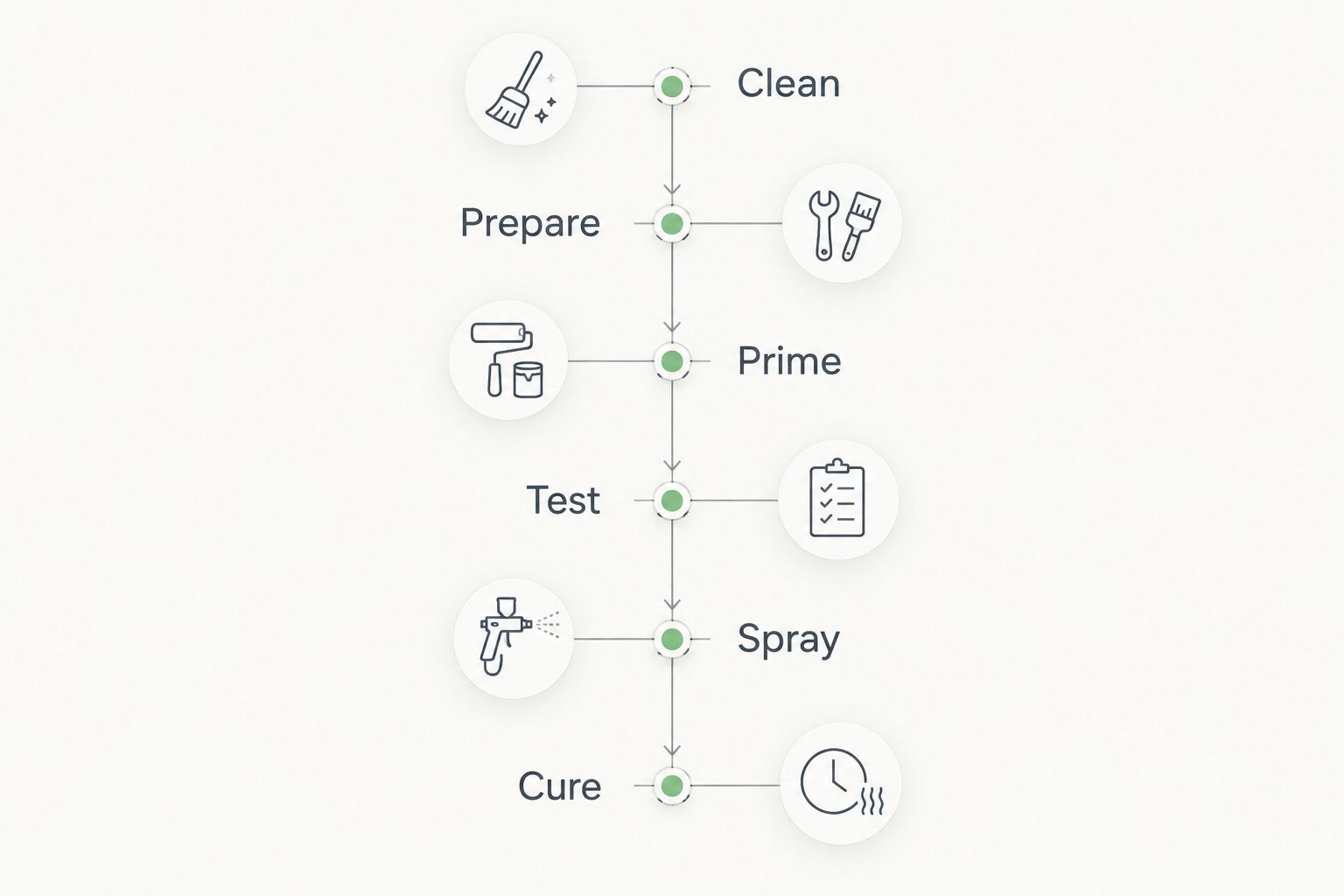
Use this sequence before production:
- Clean: Remove grease and contamination using a method compatible with the surface and coating system.
- Prepare: Repair defects and sand as required; remove sanding residue before coating.
- Prime: Use the specified primer where the substrate or coating system requires one.
- Test: Adjust the spray pattern on representative material before touching finished components.
- Spray: Maintain consistent movement, distance, and overlap according to the equipment instructions.
- Cure: Follow the coating's handling, recoating, and return-to-service instructions.
For your test session, prepare 3 sample pieces: one for pattern adjustment, one for checking coverage, and one for examining the dried result. These are planning recommendations, not manufacturer specifications. Use the same preparation and coating sequence intended for the cabinets.
Inspect the dried sample from 2 lighting angles so surface texture and coverage are easier to see. Then complete 1 sample door before moving through the remaining components. That check catches application problems before they spread across the kitchen.
Do not confuse dry-to-touch with ready for assembly. Follow the coating's cure and handling instructions before stacking doors, tightening hardware against fresh coating, or returning the kitchen to normal use.
Protect your workspace and yourself
Read the coating's safety data sheet and the sprayer manual before setting up. Respiratory protection, ventilation, ignition precautions, and protective clothing depend on the materials and equipment involved. A household fan is not automatically suitable for moving flammable vapors.
Mask adjacent surfaces and isolate the work area from occupants and pets. Plan where overspray will travel and where wet components will sit. If the space cannot support safe application, change the workflow rather than relying on a smaller spray pattern.
For homeowners who prefer professional cabinet finishing, KB's Painting Services serves Pooler, Savannah, and surrounding Georgia communities. Discuss the existing surface, desired finish, and project scope before deciding between a DIY equipment purchase and a service.
How we ranked these sprayer types
The 2026 ranking prioritizes coating compatibility, pattern control, equipment requirements, workspace fit, and cleanup. It is a selection framework, not a claim that individual models underwent hands-on testing.
Turbine HVLP leads for controlled door work because it provides a dedicated air source without compressor matching. Airless takes the full-kitchen slot because its material-delivery setup suits larger workflows. Conversion HVLP and LVLP serve readers whose existing air equipment meets the selected gun's requirements.
Which cabinet paint sprayer should you choose?
Choose turbine HVLP as the default for controlled, small-batch cabinet finishing. Choose airless with a compatible fine-finish tip when production needs justify the additional safety and setup demands.
Choose conversion HVLP or LVLP only after checking compressor compatibility. If buying equipment, preparing a spray area, and learning application technique do not fit your project, discuss cabinet finishing with KB's Painting Services instead.
The deciding question is not which gun has the longest feature list. It is which complete setup can apply your chosen coating safely and consistently.
FAQ
What's the best cabinet paint sprayer for a beginner?
A turbine HVLP system is the default category to investigate for controlled, small-batch cabinet work. Confirm that the selected system supports your coating, and practice on prepared samples before spraying doors.
Is HVLP better than airless for kitchen cabinets?
HVLP is the stronger default for controlled door finishing, while airless suits larger production workflows. Neither method guarantees a smooth finish without compatible materials, preparation, and correct setup.
Can I spray cabinet paint without thinning it?
You can spray without thinning only when the coating and equipment instructions support that setup. Never add thinner beyond the coating manufacturer's permitted limits to compensate for unsuitable equipment.
Will a small compressor run a cabinet spray gun?
A small compressor works only if it supplies the gun's required airflow at the specified pressure. Tank size alone does not confirm compatibility, and LVLP labeling does not replace checking the specifications.
Can I spray kitchen cabinets inside my house?
Spraying indoors requires a workspace that meets the coating and equipment safety instructions. Account for ventilation, respiratory protection, ignition sources, overspray containment, and separation from occupants before starting.
Why does sprayed cabinet paint look rough?
Rough texture can result from poor atomization, dry spray, surface contamination, or an unsuitable application setup. Stop and inspect your test piece, then check preparation, coating instructions, and equipment adjustments before continuing.
Should I buy a sprayer or hire a cabinet finisher?
Buy a sprayer when you can provide the preparation, safe workspace, practice, and cleanup the project requires. Hire a cabinet finisher when you want that work handled as a service rather than taking on the application yourself.
One last thing
Keep a finished sample until the kitchen is back in use. It gives you a reference for the intended color, sheen, and surface texture when checking doors under different lighting. A successful test is useful beyond the first spray session.