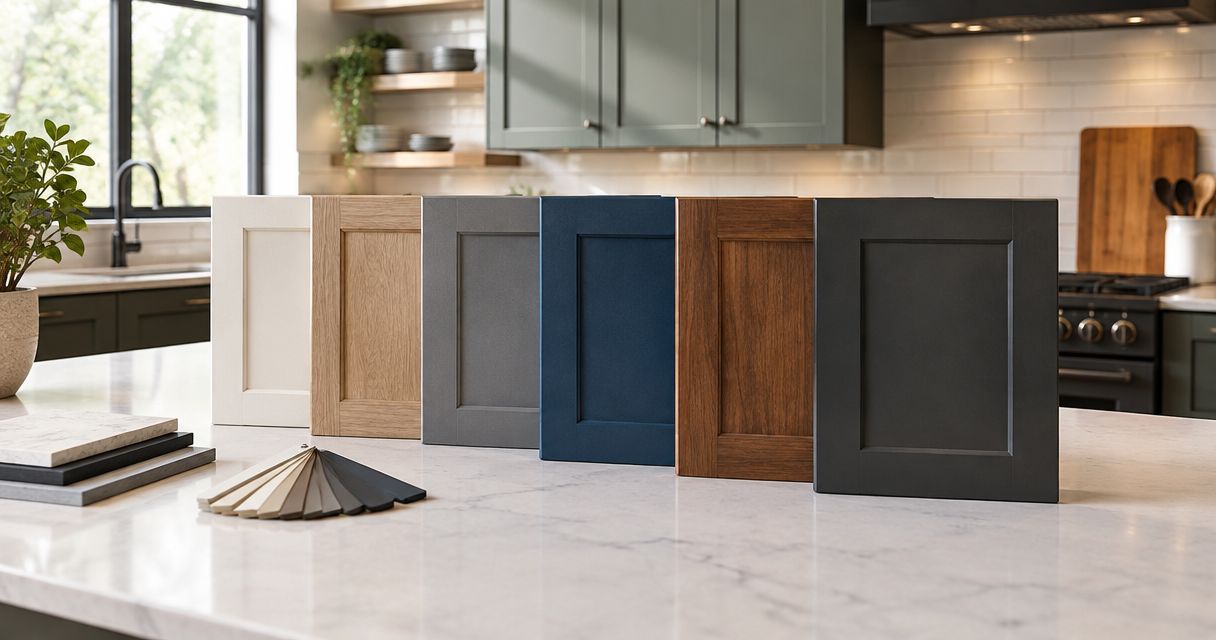
Best overall for demanding cabinet use: two-component polyurethane. Best for stained wood: conversion varnish. Best for a straightforward kitchen repaint: waterborne cabinet enamel. This 2026 guide compares cabinet finishes ranked by durability and explains which trade-offs matter before you choose a coating.
- Cabinet finishes ranked by durability: two-component polyurethane leads this practical shortlist for demanding use, but requires specialized application.
- Conversion varnish suits stained cabinets; pre-catalyzed lacquer suits shop finishing where repairability matters.
- Waterborne cabinet enamel is the practical repaint choice; preparation and full cure determine whether it performs.
- KB's Painting Services offers cabinet finishing for homeowners in Pooler, Savannah, and surrounding Georgia communities.
Why this matters
Cabinet doors face hand oils, cooking residue, repeated cleaning, and impacts around handles. A coating that looks smooth on installation day still needs to adhere to the old finish and resist those conditions after curing.
KB's Painting Services is a cabinet-finishing option for homeowners in Pooler and Savannah. When discussing your project with KB's Painting Services, separate the desired appearance from the coating requirements: painted or stained, existing surface condition, application method, and household use.
A tough coating over grease is still a weak finish system. For your 2026 cabinet project, prioritize surface preparation before comparing promises about hardness.
What makes the best cabinet finish?
Judge cabinet finishes against these criteria, not the shine of a showroom sample:
- Adhesion: The coating must bond to the cabinet substrate and any sound existing finish. Hardness cannot compensate for peeling.
- Chemical resistance: Hand oils, food residue, and cleaners challenge a finish differently from scratches. Follow the coating's approved cleaning instructions.
- Abrasion resistance: Repeated wiping and contact around pulls wear the surface. Evaluate the complete coating system, not just its topcoat.
- Moisture resistance: Sink cabinets and exposed door edges need protection from splashes. No finish fixes a persistent leak or swollen substrate.
- Application control: Mixing, film thickness, ventilation, and curing conditions affect the result. A demanding coating needs an appropriate application environment.
- Repairability: A finish that resists damage is not necessarily easy to touch up. Consider how future repairs will blend into the surrounding sheen.
Cabinet finishes at a glance
This is a practical ranking of finish families, not a laboratory leaderboard. Individual formulations differ, and a correctly applied lower-ranked finish is a better choice than an incompatible higher-ranked coating.
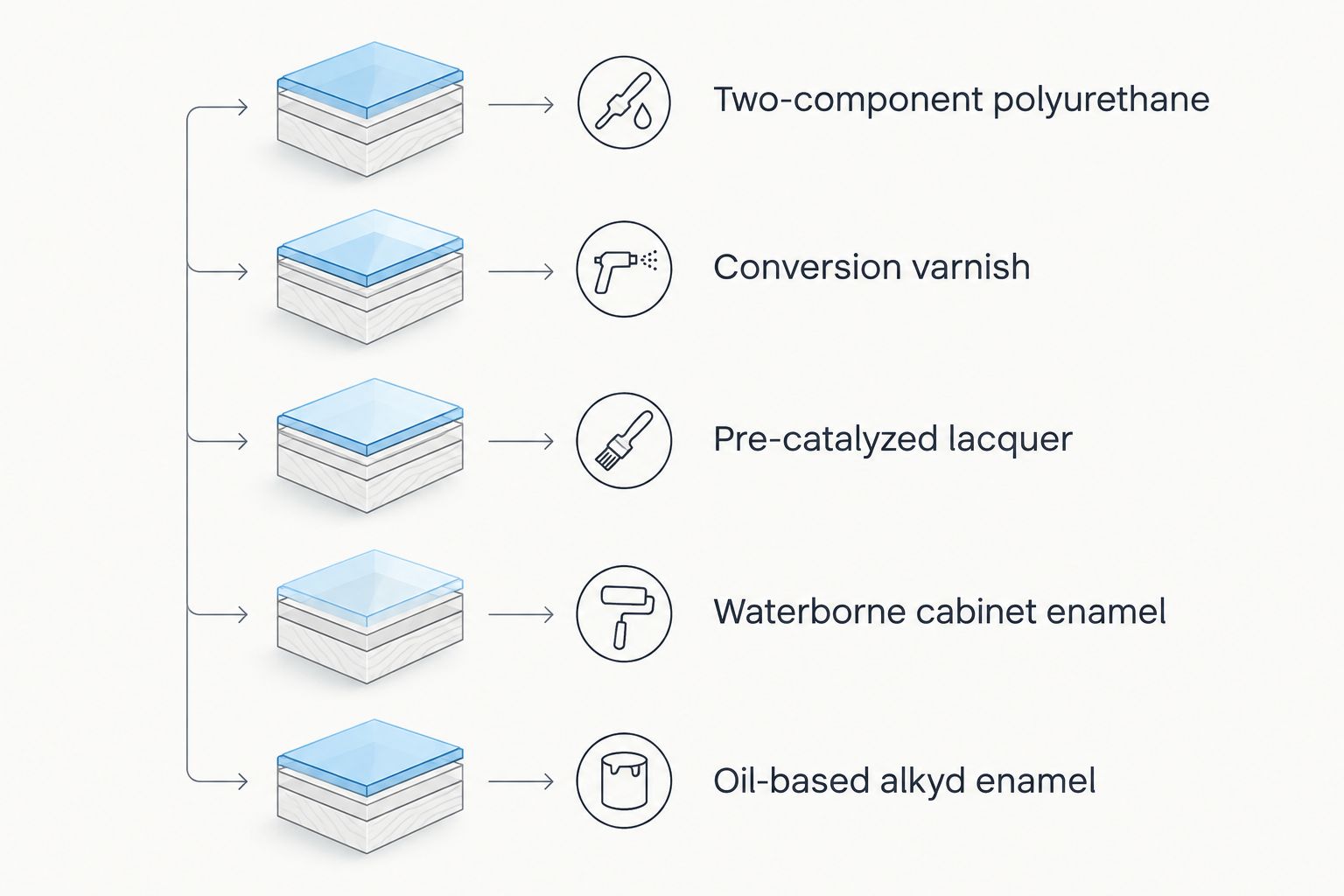
| Rank | Finish | Best for | Standout characteristic | Key limitation |
|---|---|---|---|---|
| 1 | Two-component polyurethane | Demanding use with professional application | Crosslinked coating system with strong resistance potential | Mixing and exposure controls require specialist attention |
| 2 | Conversion varnish | Stained wood finished in a controlled shop | Catalyzed clear finish suited to cabinetry | Catalyst, application, and repair requirements complicate use |
| 3 | Pre-catalyzed lacquer | Shop finishing with repairability in mind | Lacquer application with added crosslinking | Solvent exposure and coating compatibility need control |
| 4 | Waterborne cabinet enamel | Repainting installed kitchen cabinets | Cabinet-oriented finish without separate catalyst mixing | Early use before full cure risks marking and sticking |
| 5 | Traditional oil-based alkyd enamel | Compatible existing oil-painted cabinetry | Flow and leveling during brush application | Yellowing and solvent handling are meaningful drawbacks |
Choose a finish family by how the cabinets will be prepared and coated. The highest-ranked option is not automatically the right product for an occupied kitchen.
1. Two-component polyurethane: best for demanding cabinet use
Two-component polyurethane combines a coating base with a separate hardener. The resulting chemical reaction creates a crosslinked film; suitable cabinet formulations offer strong resistance to abrasion and household chemical exposure.
This is the durability-first choice for a professionally controlled finishing process. It is not a recommendation to spray a catalyzed coating in an occupied kitchen without the required exposure controls.
Two-component polyurethane pros:
- Strong resistance potential when the complete coating system is correctly specified.
- Suitable formulations exist for clear and pigmented cabinet finishes.
- Crosslinking supports a hard, cleanable surface after full cure.
Two-component polyurethane cons:
- Mixing ratios and usable working time are product-specific.
- Many systems involve isocyanates and require specialized exposure controls.
- Local touch-ups can leave visible differences in sheen or texture.
Best for: Cabinets finished by an applicator equipped for the selected catalyzed system.
Ask for the exact coating name and its technical and safety data sheets. In 2026, the phrase professional-grade paint is not an adequate specification: the preparation, primer, topcoat, and cure requirements need to be clear.
Verdict: Buy a professionally specified system; skip improvised application.
2. Conversion varnish: best for stained wood cabinetry
Conversion varnish is a catalyzed finish used in wood finishing, including cabinetry. A clear formulation protects stained wood while leaving the grain visible; pigmented formulations also exist.
Its appeal is a durable furniture-style finish, not suitability for every repaint. Existing coatings, stain compatibility, catalyst proportion, and film thickness all affect the finished system.
Conversion varnish pros:
- Well suited to clear finishing over compatible stained wood.
- Catalyzed chemistry supports resistance to moisture and household chemicals.
- Appropriate formulations provide a consistent cabinet finish in controlled application.
Conversion varnish cons:
- Catalyst and application instructions require close attention.
- Excessive film buildup can cause finish problems.
- Repairs require attention to compatibility and blending.
Best for: Stained cabinet doors and components finished in a controlled shop environment.
Choose conversion varnish when preserving wood grain is central to the project and the applicator specifies a compatible system. Do not assume an existing clear finish can accept it without preparation or testing.
Verdict: Buy for professionally finished stained cabinets; hold for an uncertain existing coating.
3. Pre-catalyzed lacquer: best for shop finishing with repair access
Pre-catalyzed lacquer contains its catalyst before application, unlike finishes that require a separate hardener to be mixed at the job. It combines lacquer application characteristics with crosslinking that improves resistance over conventional non-catalyzed lacquer.
It fits controlled shop work where spray application and future repair procedures are understood. The term pre-catalyzed does not eliminate ventilation requirements or make every lacquer compatible with every substrate.
Pre-catalyzed lacquer pros:
- No separate catalyst addition when supplied ready for use as directed.
- Suits spray finishing of cabinet doors and components.
- Offers improved resistance over conventional lacquer through catalyzed chemistry.
Pre-catalyzed lacquer cons:
- Solvent-based formulations require appropriate ventilation and ignition controls.
- Recoat windows and storage requirements vary by formulation.
- Repair blending requires product knowledge; it is not automatically invisible.
Best for: Shop-finished cabinetry where application efficiency and a defined repair method both matter.
Do not treat lacquer as one uniform category. Conventional lacquer, pre-catalyzed lacquer, and post-catalyzed systems have different requirements.
Verdict: Buy for a specified shop-finishing process; skip a generic lacquer recommendation.
4. Waterborne cabinet enamel: best for repainting installed cabinets
Waterborne cabinet enamel describes coatings formulated for cabinets and trim, including acrylic, urethane-modified, and waterborne alkyd products. These formulations are not identical, so the cabinet-use designation and technical instructions matter more than the word waterborne alone.
For many repainting decisions, this is the practical starting point. It avoids separate catalyst mixing in single-component formulations, but still requires cleaning, adhesion preparation, compatible primer where specified, and full cure.
Waterborne cabinet enamel pros:
- Single-component options simplify handling compared with separately catalyzed systems.
- Suitable products support brush, roller, or spray application as specified.
- Water cleanup is available for products whose instructions permit it.
- Cabinet-specific formulations address demands that ordinary wall paint does not.
Waterborne cabinet enamel cons:
- Dry-to-touch does not mean fully cured or ready for aggressive cleaning.
- Early door closure can cause sticking, known as blocking.
- Adhesion over slick existing coatings requires deliberate preparation.
Best for: Homeowners repainting installed cabinets without choosing a specialized catalyzed finishing process.
For a 2026 kitchen repaint, select the coating before finalizing the appearance. Then compare cabinet paint colors within the chosen system rather than buying a wall paint solely because its color looks right.
Verdict: Buy a cabinet-specific formulation for practical repainting; skip ordinary wall paint.
5. Oil-based alkyd enamel: best for compatible existing oil-painted cabinets
Traditional oil-based alkyd enamel forms a film through solvent evaporation and oxidative curing. Its flow and leveling suit brush application, but that familiar handling comes with solvent-related requirements and a tendency to yellow.
This is a narrower recommendation than waterborne cabinet enamel. Choose it for a deliberate, compatible coating system rather than assuming oil-based always means more durable.
Oil-based alkyd enamel pros:
- Good flow and leveling support brush-applied finishes.
- Forms a hard film as curing progresses.
- Provides an option for compatible existing oil-painted cabinetry.
Oil-based alkyd enamel cons:
- White and light finishes can yellow, especially where light exposure is limited.
- Solvent cleanup and ventilation add handling requirements.
- Hardness does not eliminate chipping or adhesion failures.
Best for: A compatible repaint where alkyd handling characteristics outweigh the yellowing drawback.
If maintaining a bright white appearance is your priority, traditional oil-based alkyd deserves extra scrutiny. Compare the actual formulations, not the broad labels oil and water.
Verdict: Hold unless compatibility and appearance requirements favor traditional alkyd.
How this durability ranking works
The ranking prioritizes resistance potential under correct application, then accounts for moisture exposure, cleaning, repairability, and application demands. It compares finish families rather than assigning unsupported performance scores to unnamed products.
Use the ranking to narrow the discussion, not to override a technical data sheet. Two-component polyurethane leads the demanding-use shortlist; waterborne cabinet enamel remains the practical repaint recommendation because application suitability matters alongside durability.
For any 2026 specification, request the coating identity, compatible preparation system, cure instructions, and approved cleaning guidance. A named finish without those details is only part of the decision.
Preparation that protects your finish choice
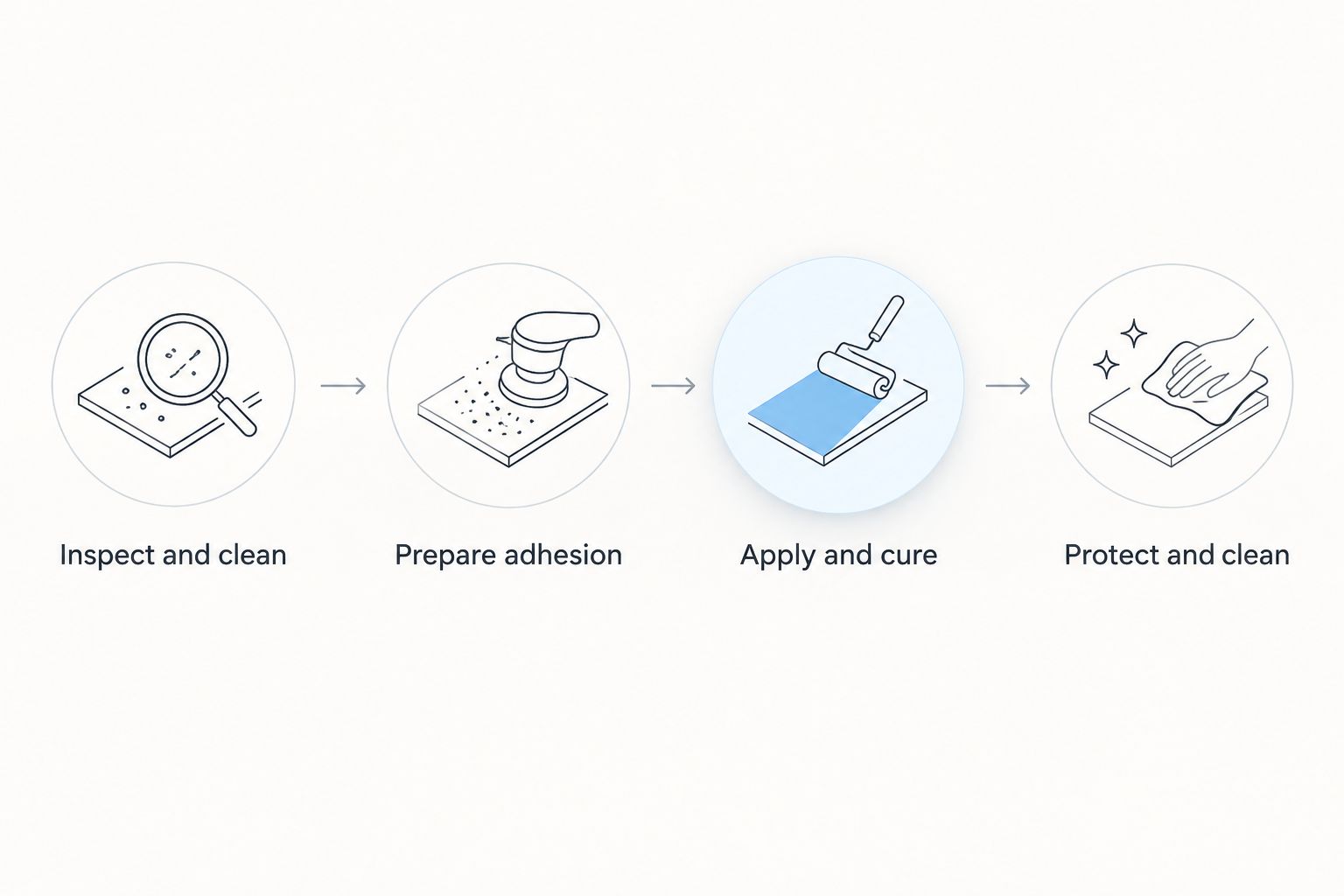
The cabinet-finishing sequence matters because each stage supports the next. KB's Painting Services offers cabinet finishing; use this checklist to frame the scope you want discussed.
Inspect and clean
Identify grease, loose coating, water damage, and worn edges before sanding. Clean with a method compatible with the surface and coating system; sanding contamination into the finish is not preparation.
Prepare adhesion
Remove failing material and dull sound glossy surfaces as required by the chosen system. Repair defects before finishing, and use a compatible primer when the coating specification calls for one.
Apply and cure
Follow the manufacturer's requirements for mixing, application, recoating, and curing. Keep doors from contacting freshly coated frames until the finish permits normal assembly and use.
Protect and clean
Fix leaks and avoid leaving standing water around sink cabinets. Clean cured finishes with approved methods rather than treating a hard coating as permission to use abrasive pads.
If your home was built before 1978, address possible lead-based paint before disturbing existing coatings. The U.S. Environmental Protection Agency's Renovation, Repair and Painting program governs covered work in pre-1978 housing; sanding is not a substitute for lead-safe planning.
Discuss your cabinet finishing project
Ask about cabinet finishing for your home in Pooler, Savannah, or surrounding Georgia communities.
Which cabinet finish should you choose?
Choose waterborne cabinet enamel as the starting point for a straightforward repaint of installed kitchen cabinets. Choose two-component polyurethane when demanding use and an appropriately equipped professional finishing process justify the added application requirements.
For stained wood, discuss conversion varnish and pre-catalyzed lacquer with the applicator. Before settling on either, confirm compatibility with the stain, substrate, and any existing coating.
For homeowners planning cabinet finishing in 2026, KB's Painting Services offers the relevant service in Pooler, Savannah, and surrounding Georgia communities. Bring your preferred appearance and the cabinets' current condition to that discussion; those details shape the coating choice.
FAQ
What's the most durable cabinet finish?
Two-component polyurethane is the durability-first choice in this practical ranking when professionally specified and correctly applied. Individual formulations differ, so the complete coating system matters more than the finish-family name alone.
Is conversion varnish better than polyurethane for cabinets?
Conversion varnish is a strong choice for professionally finished stained cabinets, but it is not automatically better than polyurethane. Compare the specific formulations, substrate compatibility, application requirements, and repair method.
What's the best finish for repainting kitchen cabinets?
Waterborne cabinet enamel is the practical starting point for repainting installed kitchen cabinets. Choose a cabinet-specific formulation and follow its cleaning, preparation, priming, and cure instructions.
Can I use wall paint on kitchen cabinets?
Choose a coating intended for cabinets rather than ordinary wall paint. Cabinet surfaces need resistance to handling, cleaning, and sticking between contacting painted surfaces.
Does a glossy cabinet finish last longer than satin?
Gloss level alone does not establish cabinet durability. Compare the coating chemistry and product instructions first, then choose sheen for appearance and maintenance preferences.
When can I clean freshly painted cabinets?
Clean freshly painted cabinets when the coating manufacturer's cure instructions permit it. Dry-to-touch and full cure are different stages, and early scrubbing can damage the finish.
Do cabinet doors need to come off before painting?
Removing cabinet doors improves access to edges and helps control the finishing process. The application plan should also address hardware, labeling, curing space, and reassembly.
Who offers cabinet finishing in Pooler and Savannah?
KB's Painting Services offers cabinet finishing for homeowners in Pooler, Savannah, and surrounding Georgia communities. The contractor also offers interior and exterior painting, staining, drywall repair, and deck and fence restoration.
One last thing
Check the door edges before judging the cabinet faces. Edges near sinks, pulls, and hinges reveal worn coatings and contact problems that a broad, smooth panel can hide. Make edge preparation, coating coverage, and door clearance part of the scope before approving the finish.