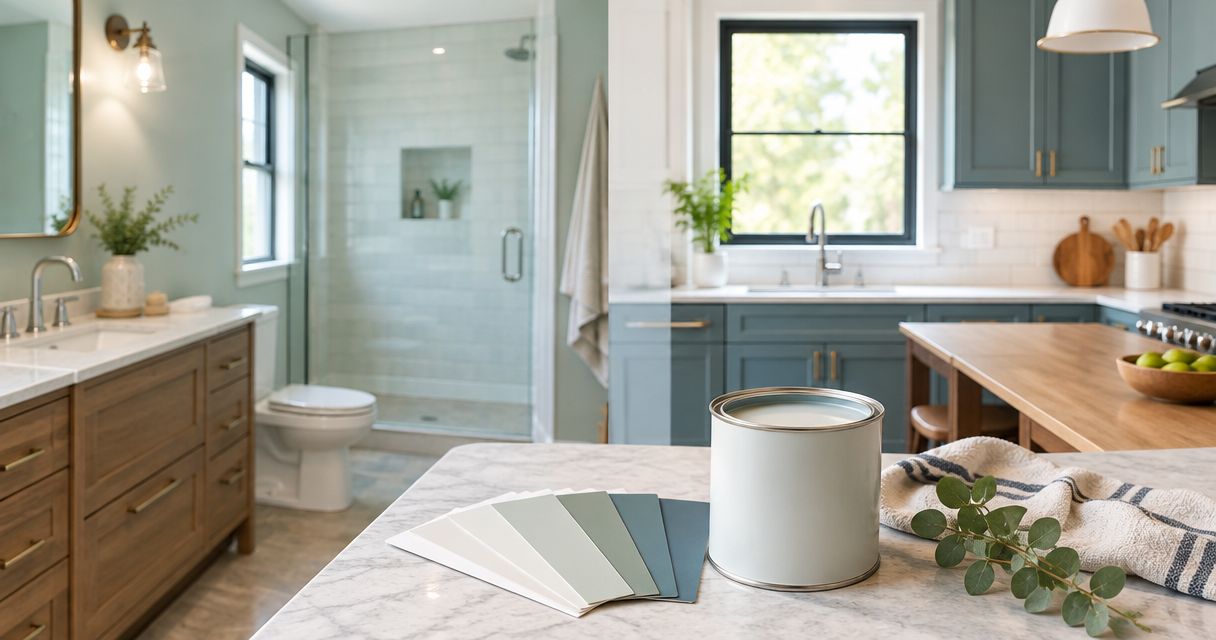
Best overall: satin for bathroom and kitchen walls. Best for trim: semi-gloss. Best low-glare option: eggshell for kitchen walls away from frequent splashes. This 2026 guide explains which finish fits each surface, where it falls short, and why the paint formula matters as much as the sheen.
- Satin is the best paint sheen for bathrooms and kitchens when you want washable walls without strong glare.
- Semi-gloss suits trim and doors; its stronger reflection makes wall defects more visible.
- Eggshell suits lower-splash kitchen walls when the specific paint supports washing.
- KB's Painting Services offers interior painting for homeowners in Pooler, Savannah, and surrounding Georgia communities.
Why this matters
Bathroom steam and kitchen splashes create different demands from a bedroom wall. You need a coating suited to the surface, the cleaning routine, and the exposure—not simply the shiniest finish on the shelf.
Choose the paint formula first, then choose the sheen. A coating labeled for bathroom use and a general-purpose coating do not become interchangeable because both say satin. Sheen describes appearance; the manufacturer's instructions establish intended uses, application conditions, and care.
For homeowners planning an interior painting project in Pooler or Savannah, KB's Painting Services offers interior painting and drywall repair. Those services address both sides of this decision: the finish you see and the surface beneath it.
What makes the best paint sheen for bathrooms and kitchens?
Use these criteria to compare finishes before choosing a color:
- Cleaning requirements: Match the coating to routine wiping, greasy fingerprints, and incidental splashes. Confirm washability in the specific product information.
- Moisture exposure: Select paint intended for the room's conditions. Bathroom wall paint does not replace waterproofing in a shower enclosure.
- Surface condition: More reflective finishes draw attention to uneven patches, sanding marks, and other defects.
- Light reflection: Check glare near mirrors, windows, and under-cabinet lighting. A sheen that looks restrained on a small chip can look different across a wall.
- Surface type: Walls, ceilings, trim, and cabinets need separate decisions. One finish does not have to cover the whole room.
- Repair expectations: Check touch-up guidance. A repair can remain visible when sheen, texture, or application differs from the surrounding coating.
For a 2026 repaint, compare the current technical information for the actual paint you intend to use. Finish names alone do not establish a universal level of scrub resistance.
Bathroom and kitchen paint sheens at a glance
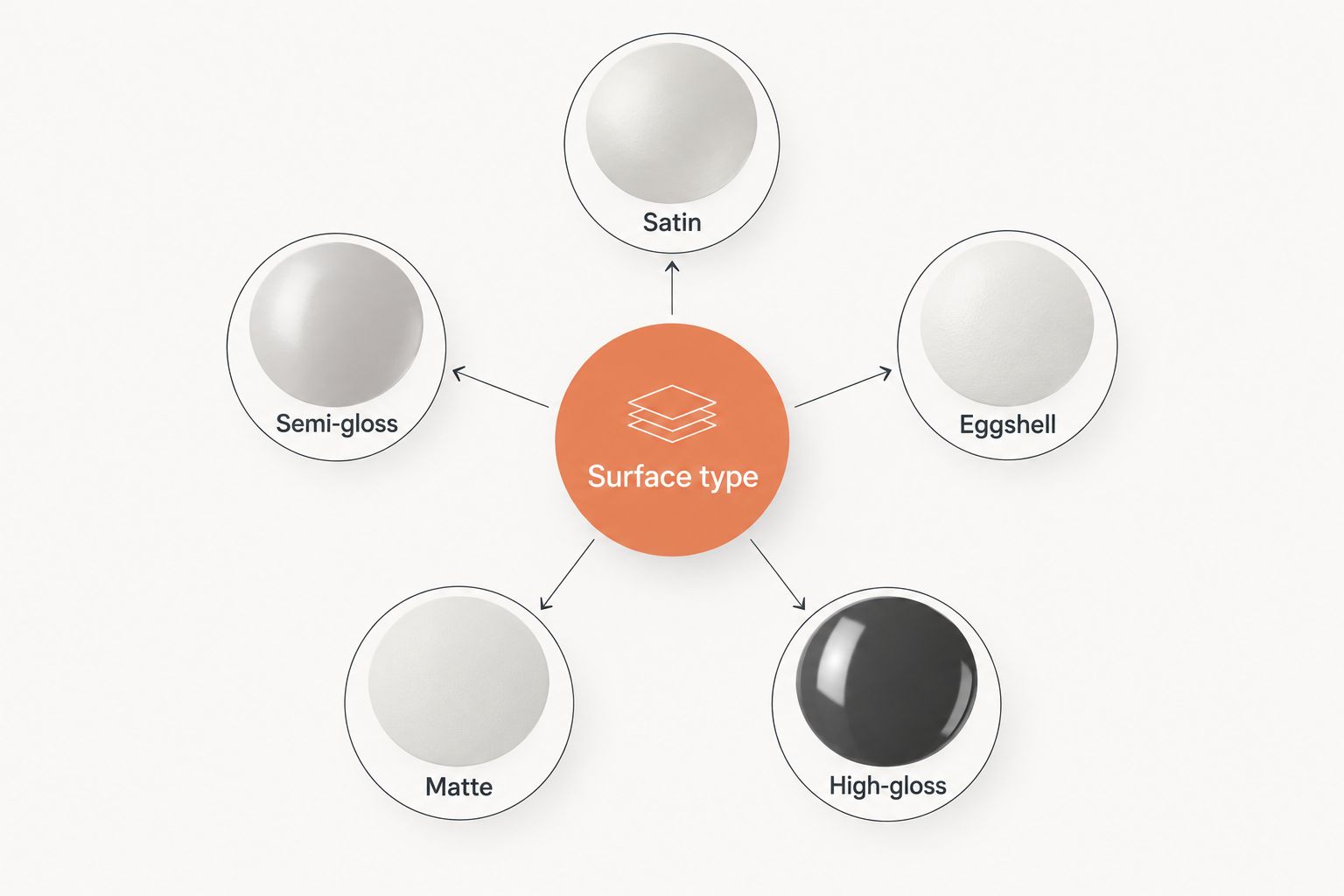
| Rank and sheen | Best for | Standout feature | Key limitation |
|---|---|---|---|
| 1. Satin | Everyday bathroom and kitchen walls | Moderate reflection with a washable formula | Highlights defects more than flatter finishes |
| 2. Semi-gloss | Trim and interior doors | More reflective finish for frequently handled surfaces | Stronger glare across broad walls |
| 3. Eggshell | Kitchen walls away from frequent splashes | Lower reflection than satin | Cleaning suitability depends on the formula |
| 4. Matte | Low-glare bathroom walls with a bathroom-rated formula | Restrained appearance on broad surfaces | Ordinary matte paint is not automatically suitable for damp rooms |
| 5. High-gloss | Deliberate accent details on carefully prepared surfaces | Strong, conspicuous reflection | Exposes preparation defects and needs careful application |
These are finish categories, not guarantees of performance. Satin from one paint range is not a substitute for checking the intended use of satin from another range. Compare the technical information, not just the finish label.
1. Satin: best paint sheen for everyday walls
Satin is the default starting point for bathroom and kitchen walls. It offers a middle ground between a flatter appearance and the stronger reflection of semi-gloss, making it useful when you want walls that look finished without dominating the room.
Choose a satin coating whose instructions support the cleaning and exposure your room receives. The satin label alone does not establish moisture resistance, stain resistance, or suitability for every substrate.
Satin pros:
- Less reflective than semi-gloss on broad wall surfaces.
- Fits both bathroom and kitchen wall schemes.
- Available in formulas intended for washable interior surfaces.
Satin cons:
- Shows uneven repairs more readily than flatter finishes.
- Can produce visible reflection near strong light sources.
- Does not replace ventilation or correct an existing moisture problem.
Best for: Homeowners repainting everyday bathroom and kitchen walls who want a practical starting point.
Before committing, inspect a dried sample beside your mirror or kitchen lighting. Look from an angle as well as straight on; that is where surface defects and reflection become easier to see.
Verdict: Buy satin for general walls when the chosen formula matches the room's conditions.
2. Semi-gloss: best paint sheen for trim and doors
Semi-gloss creates a more reflective finish than satin. It is a useful choice for baseboards, door casings, and interior doors when you want those details to stand apart from the walls.
Do not choose semi-gloss across an entire bathroom solely because the room gets humid. The extra reflection cannot compensate for unsuitable paint, poor preparation, or inadequate ventilation.
Semi-gloss pros:
- Creates a clear visual distinction between trim and walls.
- Suits frequently handled surfaces when the coating is intended for that use.
- Makes decorative woodwork more visually prominent.
Semi-gloss cons:
- Emphasizes dents, patch edges, and sanding scratches.
- Produces stronger glare than satin.
- Requires careful preparation for an even-looking finish.
Best for: Bathroom and kitchen trim and doors, rather than a default whole-room wall finish.
For your 2026 repaint, inspect existing trim for loose coatings and damage before choosing the finish. A shinier topcoat makes preparation errors easier to see; it does not cover them up.
Verdict: Buy semi-gloss for suitable trim and doors; skip it as an automatic wall upgrade.
3. Eggshell: best paint sheen for lower-splash kitchen walls
Eggshell provides less reflection than satin and more than a typical flat finish. It suits kitchen walls where your priority is a quieter appearance and the surface is away from frequent direct splashes.
The boundary is practical, not decorative. A breakfast-area wall and a wall beside food preparation do not necessarily face the same cleaning demands, even when they share a color.
Eggshell pros:
- Keeps reflection restrained across broad kitchen walls.
- Makes surface irregularities less conspicuous than glossier finishes.
- Works visually with adjacent living and dining spaces.
Eggshell cons:
- Requires a formula that supports your cleaning routine.
- Is not the default recommendation for frequently splashed walls.
- Touch-ups can remain visible against the existing finish.
Best for: Kitchen walls outside the main splash and grease zones where low glare matters.
Check whether the selected coating permits washing and follow its care instructions. Do not assume every eggshell paint tolerates the same cleaner or cleaning method.
Verdict: Buy eggshell for lower-splash kitchen walls after confirming washability; skip it where the coating is unsuitable for repeated cleaning.
4. Matte: best paint sheen for bathroom walls with low glare
Matte is an option for bathroom walls only when the specific coating is intended for bathroom conditions. A bathroom-rated matte formula lets you choose low reflection without treating an ordinary flat wall paint as a moisture-specific product.
This choice belongs in the formula discussion, not a simple glossy-versus-flat argument. Read the intended-use guidance before choosing the finish.
Matte pros:
- Reduces glare across broad wall surfaces.
- Makes minor surface irregularities less noticeable than glossier finishes.
- Provides an alternative when you dislike the appearance of satin.
Matte cons:
- Ordinary matte paint is not automatically appropriate for damp rooms.
- Cleaning instructions vary by coating.
- Low reflection does not prevent condensation or moisture damage.
Best for: Homeowners who specifically want low-glare bathroom walls and select a bathroom-rated coating.
In a 2026 bathroom update, check the exhaust system and investigate peeling before treating matte as a cosmetic fix. The right finish cannot correct an active leak or persistent condensation.
Verdict: Buy bathroom-rated matte for a deliberate low-glare scheme; skip general-purpose matte without confirmed suitability.
5. High-gloss: best paint sheen for deliberate accent details
High-gloss creates the strongest reflection in this lineup. Use it as an intentional design choice on a suitable, carefully prepared accent surface—not as the default answer to kitchen or bathroom durability.
Cabinets need a separate coating decision. Cabinet finishing involves substrate compatibility, preparation, and curing requirements as well as appearance; a glossy wall paint is not automatically a cabinet coating.
High-gloss pros:
- Gives small architectural details a conspicuous finish.
- Creates a strong contrast with lower-sheen walls.
- Suits a deliberate reflective look on an appropriate substrate.
High-gloss cons:
- Exposes surface defects and application marks.
- Creates strong glare under direct light.
- Demands careful preparation and coating selection.
Best for: Selected accent details where strong reflection is the goal.
KB's Painting Services offers cabinet finishing as well as interior painting. If your project includes cabinets, separate that scope from the wall repaint rather than specifying one coating for everything.
Verdict: Buy high-gloss only for a planned accent finish; skip it for routine bathroom and kitchen walls.
How we ranked the finishes
This ranking prioritizes everyday wall appearance, cleaning requirements, moisture suitability, and preparation demands. Satin leads because it provides the clearest starting point for general walls; the other finishes earn distinct roles rather than competing for the same job.
The order is a selection guide, not a laboratory performance ranking. Specific coatings must still meet their manufacturer's intended-use requirements. A suitable bathroom-rated matte coating belongs ahead of an unsuitable satin coating for that bathroom.
Turn the sheen choice into a painting specification
Before approving your 2026 painting plan, write down what belongs on each surface. This prevents a general instruction such as satin throughout from becoming a decision about walls, ceilings, doors, and cabinets all at once.
- Walls: Record the coating, color, sheen, and room-specific exposure requirements.
- Ceilings: Evaluate condensation and glare separately from the walls. Check the coating's suitability for the location.
- Trim and doors: Confirm substrate compatibility and the desired contrast with the walls.
- Cabinets: Treat cabinet finishing as its own scope, with the appropriate preparation and coating system.
- Repairs: Identify peeling, damaged drywall, and uneven patches before painting begins.
Ask for sample areas on a representative surface, then inspect them under the lighting you actually use. Compare appearance only after following the coating's drying instructions. Follow the full curing guidance before washing; dry to the touch and ready for cleaning are different milestones.
KB's Painting Services is a fit for homeowners seeking interior painting in Pooler, Savannah, and surrounding Georgia communities. The contractor also offers drywall repair and cabinet finishing, which are relevant when your repaint involves more than wall color.
Which paint sheen should you choose?
Choose satin as your default for bathroom and kitchen walls, then make exceptions by surface and exposure. Use semi-gloss for appropriate trim and doors, eggshell for lower-splash kitchen walls, and bathroom-rated matte when low glare is the priority.
Keep high-gloss for intentional accent work. Do not let a finish label substitute for coating compatibility, moisture control, or sound preparation. Those decisions determine whether the sheen choice makes sense for your room.
FAQ
What's the best paint sheen for bathrooms and kitchens?
Satin is the best default paint sheen for bathroom and kitchen walls when the specific coating suits the room's conditions. Use semi-gloss for appropriate trim and doors rather than automatically choosing it for every wall.
Is satin or semi-gloss better for bathroom walls?
Satin is the better starting point for bathroom walls when you want less reflection. Semi-gloss draws more attention to surface defects, and neither finish replaces a coating suited to bathroom conditions.
Can I use eggshell paint in my kitchen?
Yes, eggshell suits lower-splash kitchen walls when the chosen coating supports the required cleaning. Check the manufacturer's instructions before using it near frequent grease or splash exposure.
Can I use matte paint in a bathroom?
Yes, use matte in a bathroom when the specific coating is intended for bathroom conditions. Do not assume ordinary matte wall paint provides the same suitability as a bathroom-rated formula.
Should kitchen cabinets have the same paint as the walls?
Kitchen cabinets need a separate coating decision from the walls. Choose a system compatible with the cabinet substrate and follow its preparation, application, and curing requirements.
Will shiny paint stop bathroom mold?
No, choosing a shinier finish does not fix the moisture conditions that support mold. Address leaks, condensation, and ventilation, and follow appropriate remediation guidance before repainting affected surfaces.
How do I choose a paint sheen before hiring a painter?
Choose the intended finish separately for walls, ceilings, trim, and cabinets, then confirm coating suitability with the painter. KB's Painting Services offers interior painting, drywall repair, and cabinet finishing for homeowners in Pooler, Savannah, and surrounding Georgia communities.
One last thing
Test the sheen on the least flattering patch of wall—not only the smoothest one. An area near side lighting or a previous drywall repair tells you more about the finished appearance than a sample placed in forgiving light.
For a 2026 project, make that sample part of the decision before painting the whole room. If the reflection exposes defects you dislike, improve the preparation or choose an appropriate lower-sheen coating. Changing color alone will not change the sheen's reflection.