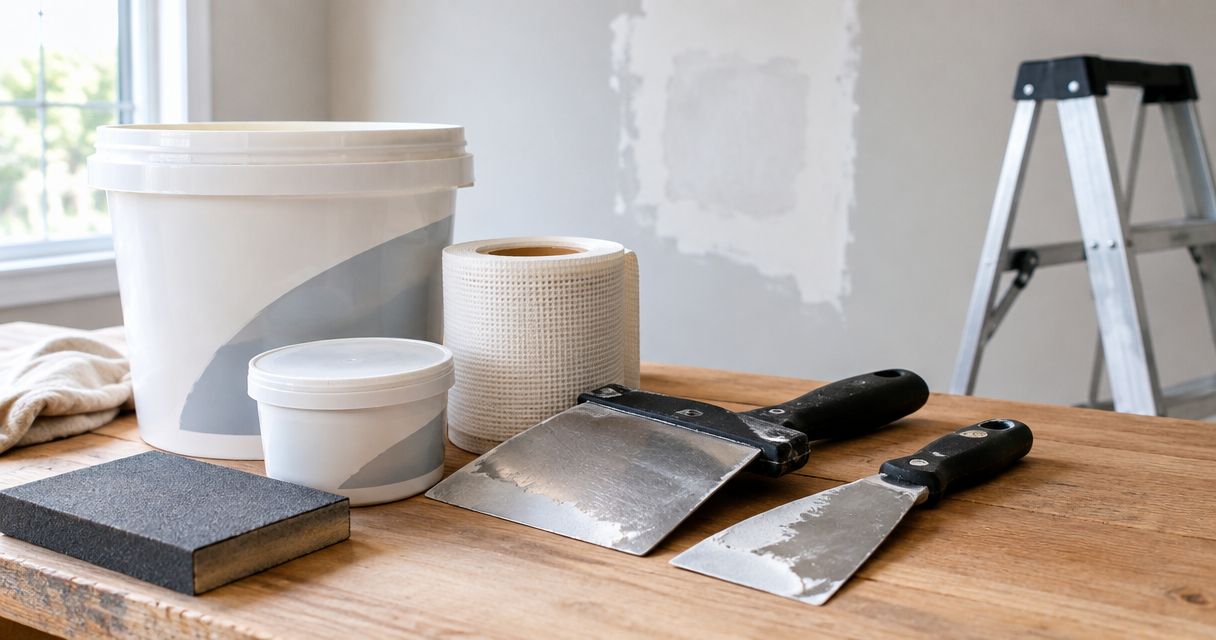
Best overall for taped drywall repairs: premixed all-purpose joint compound. Best for small nail holes: lightweight spackling. Best for deeper fills: setting-type joint compound. This 2026 guide compares the best drywall repair products by damage type, preparation requirements, and the finish you need before painting.
- Premixed all-purpose joint compound is the best drywall repair product for general taped patches and seams.
- Lightweight spackling suits nail holes; replacement drywall suits larger openings that need solid backing.
- Paper tape reinforces seams; self-adhesive mesh patches cover suitable small holes but still need joint compound.
- KB's Painting Services is a professional option for homeowners needing drywall repair in Pooler, Savannah, and surrounding Georgia communities.
Why this matters
A smooth-looking patch is not necessarily a sound repair. Spackling fills a shallow defect, tape reinforces a joint, and replacement drywall restores a missing section. Those jobs require different materials.
KB's Painting Services is a professional drywall repair option for homeowners in Pooler, Savannah, and surrounding Georgia communities. If you want repair and painting handled as services rather than separate DIY tasks, KB's Painting Services offers both.
For your 2026 project, choose the repair method before choosing the filler. Painting over a loose edge, unsupported hole, or unresolved moisture problem does not fix the underlying damage.
What makes the best drywall repair products?
Judge drywall repair products against these criteria before comparing the options:
- Damage fit: The material must suit a nail hole, seam crack, puncture, or missing section—not simply cover it.
- Support: Openings need a backing or repair method that supports the finished patch.
- Working time: Premixed compounds allow a different working pace than compounds that harden chemically after mixing.
- Finish control: The repair needs feathered edges, not a thick mound that becomes visible after painting.
- Preparation demands: Mixing, taping, sanding, and priming affect how much work the repair requires.
- Failure limits: No filler corrects an active leak, persistent movement, or damaged material left underneath it.
Use this checklist for a 2026 repair whether you handle one wall dent or prepare several rooms for repainting. The best choice is the material that completes the repair correctly, not the container with the broadest promise.
Drywall repair products at a glance
These are material categories, not interchangeable branded kits. Several belong in the same repair: replacement drywall, paper tape, and joint compound work together.
| Rank and material | Best for | Standout feature | Key limitation |
|---|---|---|---|
| 1. Premixed all-purpose joint compound | General taped repairs | Ready-to-use material for embedding tape and coating patches | Air-drying fills need drying time and can shrink |
| 2. Lightweight spackling | Small nail holes and shallow dents | Simple spot filling without mixing powder | Not a substitute for tape or structural backing |
| 3. Setting-type joint compound | Deeper fills and staged repair work | Hardens through a chemical setting reaction | Limited working time after mixing |
| 4. Paper drywall tape | Seams and inside corners | Reinforces joints when embedded in compound | Poor embedding leaves bubbles or loose sections |
| 5. Self-adhesive mesh patch | Suitable small punctures | Provides a surface over an opening | Raised edges require careful feathering |
| 6. Replacement drywall with backing | Larger holes and damaged sections | Restores the missing wall panel | Requires cutting, fastening, taping, and finishing |
1. Premixed all-purpose joint compound: best for general repairs
Premixed all-purpose joint compound is the default choice for embedding paper tape and coating ordinary drywall patches. You spread it with a drywall knife and feather the repair into the surrounding wall. It is not a structural plug for an unsupported opening.
A 6-inch knife helps place compound over a localized repair. A 10-inch knife helps spread the finishing coat beyond the patch, reducing an abrupt edge. These are useful tool choices, not rules that determine the permitted hole size.
Premixed all-purpose joint compound pros:
- Requires no powder mixing before an ordinary repair.
- Works with paper tape for joints and patch seams.
- Supports successive coats that spread wider across the wall.
Premixed all-purpose joint compound cons:
- Thick applications take longer to dry than thin applications.
- Drying shrinkage can leave depressions that need another coat.
- An unsupported hole still needs a suitable patch or backing.
Best for: Homeowners and professionals handling general taped drywall repairs.
Verdict: Buy for ordinary patch finishing; skip it as a standalone bridge across a hole.
2. Lightweight spackling: best for small nail holes
Lightweight spackling fills small surface defects such as nail holes and shallow dents. It is the simpler choice when the wall remains intact and does not need reinforcement. Remove loose material before applying it.
A 4-inch putty knife gives you room to scrape a small fill flush without spreading material across a large area. Keep the repair localized, then follow the product's instructions for drying, sanding, and painting.
Lightweight spackling pros:
- Suits isolated cosmetic defects.
- Avoids mixing a powdered compound.
- Allows a small repair without adding tape to an intact wall.
Lightweight spackling cons:
- Does not reinforce a moving crack or drywall seam.
- Does not replace backing beneath a hole.
- Overfilling still leaves a visible lump after painting.
Best for: Homeowners touching up small fastener holes before repainting.
Verdict: Buy for small surface defects; skip it for broken seams or missing drywall.
3. Setting-type joint compound: best for deeper fills
Setting-type joint compound starts as powder mixed with water. It hardens through a chemical reaction rather than relying only on water evaporation. That distinction makes it useful for deeper fills and repair work where an air-drying compound would be an awkward first layer.
Setting is not the same as becoming fully dry. Follow the selected product's instructions before sanding, priming, or painting, and mix only what you can apply within its stated working time.
Setting-type joint compound pros:
- Provides an alternative to thick air-drying fills.
- Comes in formulations with different stated setting times.
- Can form a base beneath a separate finishing coat.
Setting-type joint compound cons:
- Requires mixing and attention to working time.
- Hardened leftovers cannot be restored by adding water.
- Sanding characteristics differ between formulations.
Best for: Experienced DIY users and professionals making deeper repairs.
Verdict: Buy when the repair benefits from a setting compound; skip it if you need unrestricted working time.
4. Paper drywall tape: best for seams and inside corners
Paper drywall tape reinforces joints when embedded in a bed of joint compound. It is a repair component, not a filler. Its crease helps it fit inside corners.
A crack along a panel joint needs more than a cosmetic smear when the tape or joint has failed. Remove failed material, check for loose drywall, and address the cause before rebuilding the joint.
Paper drywall tape pros:
- Reinforces repaired seams.
- Folds along its crease for inside corners.
- Works with a properly embedded compound bed.
Paper drywall tape cons:
- Insufficient compound underneath can leave bubbles.
- Requires finishing coats over the tape.
- Cannot correct ongoing movement by itself.
Best for: Repairs to drywall joints, patch seams, and inside corners.
Verdict: Buy for seam reinforcement; skip filler-only repairs where tape is needed.
5. Self-adhesive mesh patch: best for suitable small punctures
A self-adhesive mesh patch covers an opening and provides a surface for applying compound. Patch construction varies, so follow the selected patch's instructions and size limits. Do not assume every mesh patch suits the same damage.
The patch sits over the wall surface rather than replacing the missing panel flush. Spread finishing compound beyond its edges to reduce the visible transition. A larger opening or crumbling surrounding drywall calls for a different repair.
Self-adhesive mesh patch pros:
- Covers a suitable opening without cutting a replacement panel.
- Gives compound a supported surface over the hole.
- Simplifies some isolated puncture repairs.
Self-adhesive mesh patch cons:
- Its raised profile requires wider feathering.
- Adhesion depends on a clean, sound surrounding surface.
- It is not a universal repair for large holes or damaged board.
Best for: Isolated small punctures that meet the patch manufacturer's instructions.
Verdict: Buy for a compatible small hole; skip it when the surrounding drywall is unsound.
6. Replacement drywall with backing: best for larger holes
Replacement drywall restores a missing or damaged section of wall. Cut back to sound material, provide suitable support, and fasten the replacement piece before taping and finishing its seams. Match the existing board thickness and the wall assembly's requirements.
This method requires more preparation than spreading filler, but it addresses missing material directly. If the wall has a required fire-resistance rating, the repair must preserve that assembly rather than use an improvised patch.
Replacement drywall pros:
- Replaces missing material instead of spanning it with filler.
- Allows removal of a damaged section.
- Provides a supported panel for taped finishing.
Replacement drywall cons:
- Requires cutting, fastening, and several finishing steps.
- Creates multiple seams to blend into the wall.
- Work near concealed wiring or plumbing requires care.
Best for: Larger openings, broken panel sections, and damage requiring board removal.
Verdict: Buy for missing or unsound drywall; skip shortcuts that leave the repair unsupported.
Choose the repair before opening the container
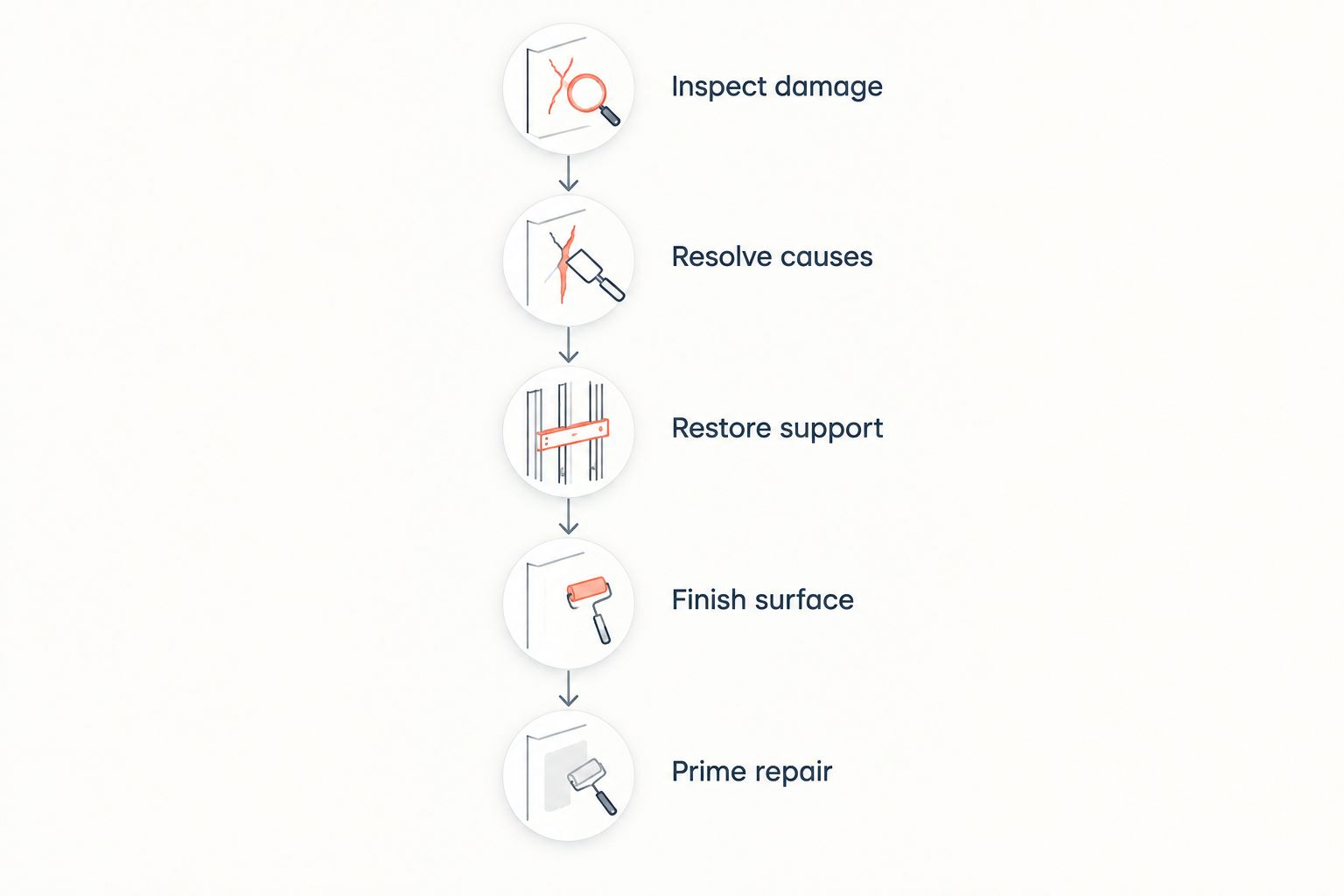
Use this sequence for your 2026 project. It keeps a cosmetic repair from disguising a problem that needs another approach.
- Inspect damage: Identify the hole, dent, failed seam, or damaged panel. Check for dampness, loose edges, and recurring cracks.
- Resolve causes: Address leaks or other active causes before covering the affected area. Do not close a wet wall with fresh filler.
- Restore support: Use a suitable patch or supported replacement panel wherever drywall is missing.
- Finish surface: Apply the appropriate compound and reinforcement, then feather the edges into the existing wall.
- Prime repair: Follow the compound and coating instructions before repainting the repaired area.
Stop and assess the job if you find persistent dampness, suspected mold, a repeatedly reopening crack, or damage around utilities. The right container of compound does not resolve those conditions.
How these picks rank
This 2026 ranking puts broadly useful finishing material first, then separates the remaining options by repair type. Damage fit and support come before application convenience. Finishing difficulty matters only after the repair method is sound.
No single material wins every job. Spackling is simpler for a nail hole, paper tape belongs at a failed seam, and replacement drywall belongs where a section is missing. Brand packaging does not change those distinctions.
Which drywall repair products should you choose?
Choose premixed all-purpose joint compound as your default for taped repairs, not as your default for every defect. Use lightweight spackling for isolated nail holes and setting-type compound when deeper filling suits the repair.
For homeowners comparing drywall repair products with hiring a contractor, KB's Painting Services offers drywall repair and interior painting. The decision is whether you want to handle diagnosis, preparation, finishing, and painting yourself—not merely whether you can spread filler.
Discuss your drywall repair
KB's Painting Services offers drywall repair and painting for Pooler, Savannah, and surrounding Georgia communities.
FAQ
What's the best drywall repair product for nail holes?
Lightweight spackling is the simplest choice for small nail holes in otherwise sound drywall. Remove loose material, fill the defect, and follow the product's finishing instructions.
Is spackling better than joint compound for drywall repair?
Spackling is better suited to small cosmetic fills; joint compound is better suited to taped joints and patch finishing. Neither material replaces the support needed beneath an opening.
Can I fill a drywall crack without using tape?
A failed drywall seam needs reinforcement rather than a filler-only cover-up. Check for loose board or ongoing movement, then rebuild the joint with an appropriate tape-and-compound system.
What's the best way to repair a large drywall hole?
A supported replacement drywall section is the right approach when an opening exceeds a patch system's limits or the surrounding board is damaged. Fasten the replacement, tape its seams, and finish the surface before painting.
Can I paint setting-type compound as soon as it hardens?
Hardening does not establish that setting-type compound is ready for paint. Follow the manufacturer's drying and coating instructions, then prime the repair as required.
Do I need to prime a drywall patch before painting?
Prime exposed repair material as directed by the compound and paint manufacturers. Unsealed repair areas can absorb paint differently from the surrounding painted wall and show through the finish.
Who offers professional drywall repair near Pooler and Savannah in 2026?
KB's Painting Services offers drywall repair for homeowners in Pooler, Savannah, and surrounding Georgia communities. The veteran-owned contractor also offers interior and exterior painting.
One last thing
Check the repair under light coming across the wall before you paint. Side lighting exposes ridges and raised patch edges that flat overhead light hides. Correct the shape first; an extra coat of paint is not a substitute for a smooth surface.