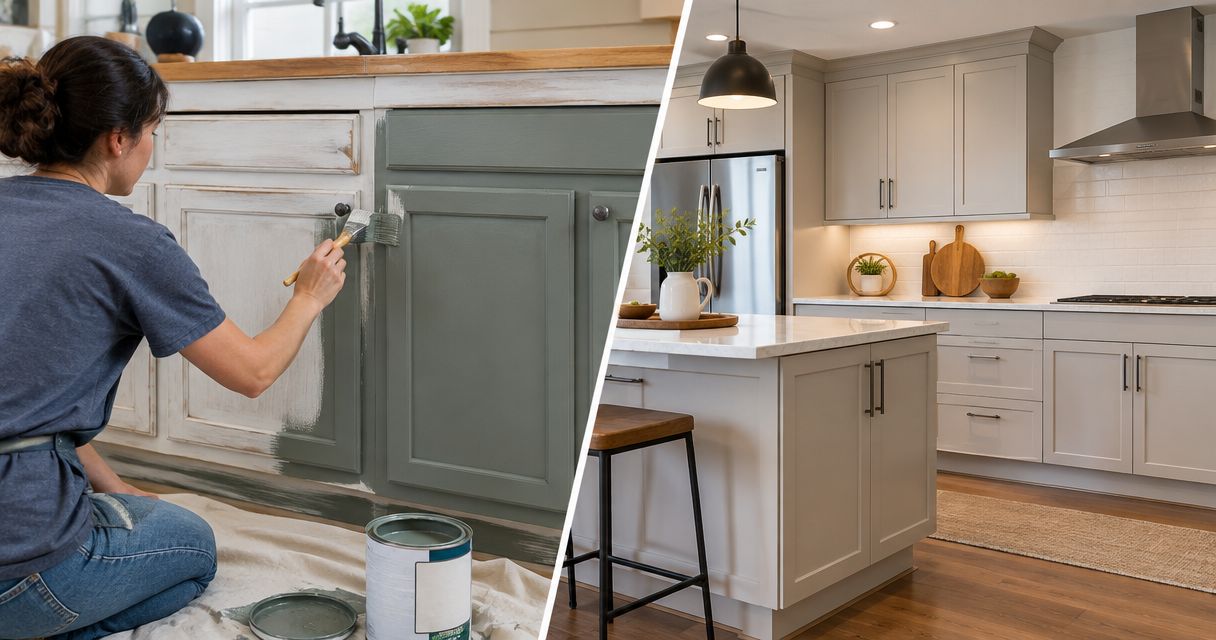
Cabinet replacement generally costs more than refinishing because it adds new cabinets, removal, and installation to the project. The important exception is damaged or unsuitable cabinetry: refinishing changes the finish, but it does not correct a poor layout or restore structurally failed cabinet boxes.
- Cabinet refinishing vs replacement cost comes down to what stays: keeping sound boxes avoids buying and installing new cabinets.
- Refinishing is best for sound cabinets when you want a different finish, not a different kitchen layout.
- Replacement is best for failed cabinet boxes or layout changes; include related installation work in the comparison.
- KB's Painting Services offers cabinet finishing for homeowners in Pooler, Savannah, and surrounding Georgia communities.
Why this matters
A cheaper proposal is not automatically the better project. Refinishing and replacement solve different problems, so comparing their totals without comparing their scope creates a false choice.
For your 2026 project, decide whether you dislike the cabinets' appearance or how the kitchen works. A worn finish points toward refinishing; failing boxes or a layout that obstructs everyday use points toward replacement.
KB's Painting Services is best for homeowners in Pooler and Savannah seeking cabinet finishing rather than a kitchen layout change. You can review KB's Painting Services when your project centers on the existing cabinetry.
Cabinet refinishing vs replacement: which costs more?
Replacement has the broader construction scope. You purchase cabinet units, remove the existing cabinetry, and install the replacements; depending on the project, you also address countertops, trim, wall repairs, or connections disturbed by the work.
Refinishing retains the cabinet structure and focuses on surface preparation and a new finish. The comparison changes when the existing cabinets need substantial repair, when the desired finish requires extensive stripping, or when the replacement proposal excludes related work.
| Option | Best for | What the work addresses | Main advantage | Main limitation |
|---|---|---|---|---|
| Cabinet refinishing | Sound cabinets with an acceptable layout | Existing surfaces and finish | Retains the cabinets you already own | Does not change box dimensions or door profiles |
| Cabinet replacement | Failed boxes or a different layout | Cabinet units, configuration, and installation | Changes storage and cabinet structure | Adds removal, installation, and related work |
Compare the complete project, not a refinishing quote against a cabinet-only purchase. A replacement total that leaves out installation is not equivalent to a finishing proposal that includes preparation and application.
For a useful 2026 comparison, ask both contractors to identify exactly what remains, what changes, and what work falls outside their proposals. That written boundary matters more than an attractive headline total.
Refinishing: best for sound cabinets and appearance changes
Refinishing makes sense when your cabinet boxes remain sound, the doors and drawers function, and the current arrangement serves your household. You are paying to improve existing surfaces rather than replace the storage system.
The advantage is preservation. You keep the cabinet dimensions and avoid removing sound units simply because their finish looks tired. The limitation is equally important: a new coating cannot increase drawer capacity, straighten a failed box, or change an awkward corner arrangement.
Ask how the contractor will handle these areas:
- Doors and drawer fronts: Confirm which faces and edges receive the finish.
- Cabinet frames: Identify all visible surfaces included in the work.
- Exposed ends: Check island sides, end panels, and other surfaces outside the main cabinet run.
- Interiors: Establish whether shelves and cabinet interiors remain unchanged.
- Hardware: Clarify removal, reinstallation, and any hole repairs.
A proposal that says only “paint cabinets” leaves too much undefined. Have the contractor describe preparation, the finish system, and the included surfaces before you approve the work.
Choose refinishing when the existing cabinets deserve to stay. Do not choose it solely because you want to avoid confronting a structural problem.
Replacement: best for failed boxes or a different layout
Replacement is the stronger option when retaining the cabinetry prevents you from getting the kitchen you need. It allows different cabinet dimensions, storage arrangements, and door styles rather than limiting the project to the existing structure.
Its advantage is flexibility. Its drawback is the broader scope: removing and installing cabinets introduces work beyond the cabinet finish itself.
Inspect the connections between cabinets and surrounding materials before treating replacement as a simple swap. Countertops rest on base cabinets, backsplashes meet the countertop, and trim closes gaps around cabinet runs. Your proposal should explain what happens to each affected element.
Replacement also deserves consideration when damage extends through cabinet panels or when fastening points no longer hold securely. A coating is not a structural repair. Establish the cause of moisture damage before installing or refinishing anything in the affected area.
Choose replacement when keeping the boxes means keeping the problem. For a 2026 renovation, resolve the desired layout before choosing finishes; otherwise, you risk paying to improve cabinets you subsequently remove.
Why cabinet refinishing vs replacement cost varies
The useful question is not whether every refinishing job beats every replacement job. It is which work your particular kitchen requires. These scope differences explain why proposals diverge:
- Existing condition: Grease, loose coatings, damaged edges, and previous repairs affect preparation. Structural damage changes whether refinishing is appropriate at all.
- Finish change: A painted result and a visible wood-grain result require different preparation decisions. Discuss the existing coating and desired appearance together.
- Included surfaces: Doors alone are a different scope from doors, frames, exposed ends, trim, and interiors. Compare the same surfaces across finishing proposals.
- Cabinet configuration: Replacement that preserves the arrangement differs from a project that changes cabinet positions or dimensions. The latter needs a clear plan for affected surrounding work.
- Related repairs: Hardware holes, damaged trim, wall damage, and countertop work need explicit treatment. Ask whether each item is included, excluded, or separately quoted.
- Application and protection: Identify where finishing occurs, what remains in the kitchen, and how adjacent surfaces are protected. Those details define the work you are purchasing.
Do not use a neighbor's project total as your specification. Even similar-looking kitchens can have different coatings, damage, and included surfaces.
How do you compare refinishing and replacement quotes fairly?
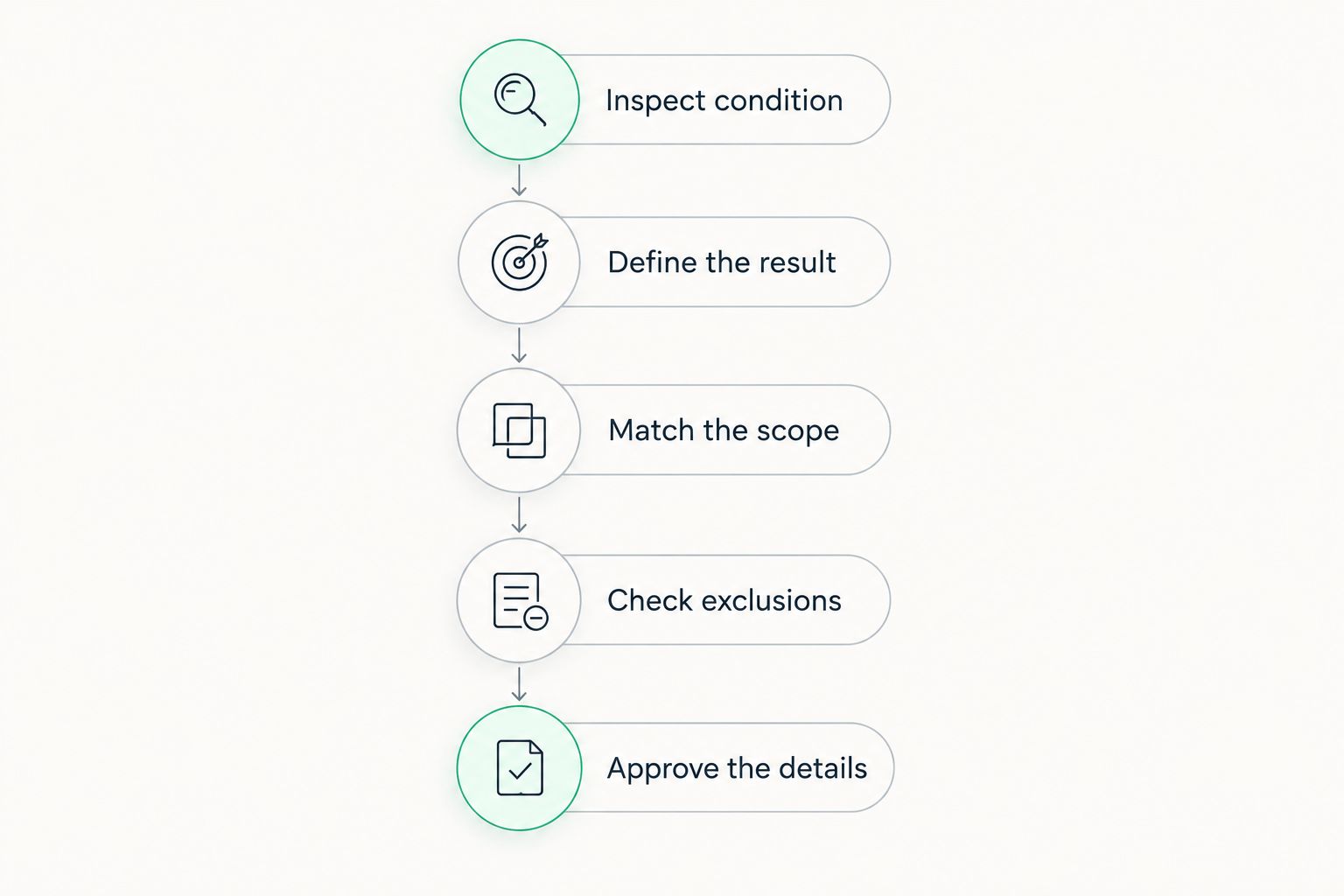
Request 2 written scopes, one for refinishing and one for replacement, using the same description of your desired result. Keep appearance goals separate from functional requirements so neither contractor has to guess what success means.
- Inspect condition. Open doors and drawers, examine cabinet bottoms and sink-base areas, and identify loose or damaged components. Separate finish wear from structural concerns.
- Define the result. State whether you want a color change, visible wood grain, different door styling, or a different arrangement. These goals do not all point to the same service.
- Match the scope. List included surfaces, repairs, hardware work, protection, and cleanup. For replacement, include removal, installation, and treatment of affected surrounding materials.
- Check exclusions. Ask who handles any work outside the main proposal. An exclusion still belongs in your project plan, even when a different contractor performs it.
- Approve the details. Resolve the finish, repair approach, and responsibilities before work starts. Record changes in writing rather than relying on a conversation.
This sequence gives you a decision you can defend. You are comparing finished outcomes, not two totals attached to different assumptions.
What should you inspect before choosing refinishing?
Use 3 condition checks before committing to a finish change: structure, function, and surface. Each answers a different question, and a good-looking door does not establish that the cabinet behind it is sound.
Structure: can the cabinets remain?
Look for swollen panels, separated joints, sagging components, and loose attachment points. Pay particular attention to areas around plumbing and previous leaks. Identify and correct the source of moisture rather than covering the evidence.
Local damage does not automatically require replacing every cabinet. Have the damaged component assessed, then compare the repair scope with the alternative before deciding.
Function: does the kitchen work?
Open every door and drawer. Note rubbing, poor access, inconvenient storage, and appliances that interfere with movement. Distinguish an adjustment issue from a cabinet arrangement that cannot meet your needs.
Refinishing preserves the existing configuration. If your central complaint is where cabinets sit or what they hold, solve that question before selecting a color.
Surface: can it receive the intended finish?
Ask the contractor to assess the existing coating, contamination, veneer condition, and any peeling surface layer. Different substrates require different preparation; appearance alone does not establish compatibility.
Do not assume sanding and painting will conceal every defect. Ask which marks will be repaired, which material characteristics will remain visible, and what the finished surface should look like.
Is refinishing worth it if you plan to sell?
Refinishing fits a sale-preparation project when the cabinets function and the main issue is appearance. It does not establish a resale return, and a fresh finish does not excuse undisclosed or unresolved damage.
For a 2026 sale, separate necessary repairs from cosmetic preferences. Correct moisture problems and failed components first; then decide whether the existing cabinetry needs a finish change to present cleanly.
Replacement makes sense when cabinet failure or an unusable arrangement remains a central problem after basic repairs. Do not expand a cosmetic project into a full cabinet renovation without a clear reason tied to the property.
Can refinishing change your cabinet style?
Refinishing changes color, sheen, and surface appearance, but it retains the existing door shape and cabinet dimensions. If you dislike an arched panel or decorative profile, paint does not remove that geometry.
Bring a description of the result you want to the contractor. A simple color change is a different request from making traditional doors look like flat-panel doors.
For cabinet finishing, KB's Painting Services serves homeowners in Pooler, Savannah, and surrounding Georgia communities. Keep the discussion centered on the actual doors, boxes, and finish goal rather than assuming a reference photo can be reproduced on any cabinetry.
Should you replace countertops before deciding on cabinets?
Decide whether the base cabinets will stay before committing to countertop work. The countertop and cabinet plans need to agree on dimensions, support, and the intended arrangement.
If you plan to retain the cabinets, tell the finishing contractor what countertop work is planned and coordinate protection and access. If you plan to replace cabinets, settle the cabinet layout before treating the countertop dimensions as final.
For a 2026 project involving multiple trades, put responsibilities in writing. Ask who protects completed surfaces and who addresses damage caused during later work.
FAQ
Is cabinet refinishing cheaper than replacing cabinets?
Cabinet refinishing generally costs less when the existing boxes are sound and the layout stays. Compare complete scopes, because a cabinet-only replacement proposal excludes work that a finishing proposal might already include.
How much does cabinet refinishing cost in 2026?
A useful 2026 cabinet refinishing quote requires an assessment of cabinet condition, included surfaces, preparation, and the intended finish. Ask for those items in writing rather than comparing an unexplained total.
Can I refinish cabinets with water damage?
Water-damaged cabinets need a condition assessment before refinishing. Correct the moisture source and establish whether affected components require repair or replacement; a new finish does not restore structural strength.
Will refinishing make my cabinets look like a different door style?
Refinishing changes the finish, not the door profile. If you want a different panel shape or cabinet dimensions, discuss that requirement separately from the coating work.
Do I need to paint the inside of my kitchen cabinets?
Cabinet interiors do not automatically belong in a refinishing scope. Decide whether you want them finished and have the proposal distinguish interiors from doors, frames, and exposed ends.
Should I replace cabinets if I dislike my kitchen layout?
Replacement is the better fit when different cabinet dimensions or positions are essential to your plan. Refinishing retains the existing configuration and therefore does not solve layout problems.
Who offers cabinet finishing near Pooler and Savannah?
KB's Painting Services offers cabinet finishing for homeowners in Pooler, Savannah, and surrounding Georgia communities. Describe the existing cabinet condition and the finish change you want when discussing the project.
One last thing
Ask about approving 1 sample door before authorizing the finish across the kitchen. Use it to discuss color, sheen, visible grain, edge treatment, and the appearance of repaired areas under your actual kitchen lighting.
A sample is a decision aid, not proof that damaged cabinets should stay. Choose the structure first and the finish second. That order keeps a cabinet refresh from becoming money spent on cabinetry your kitchen still needs to lose.